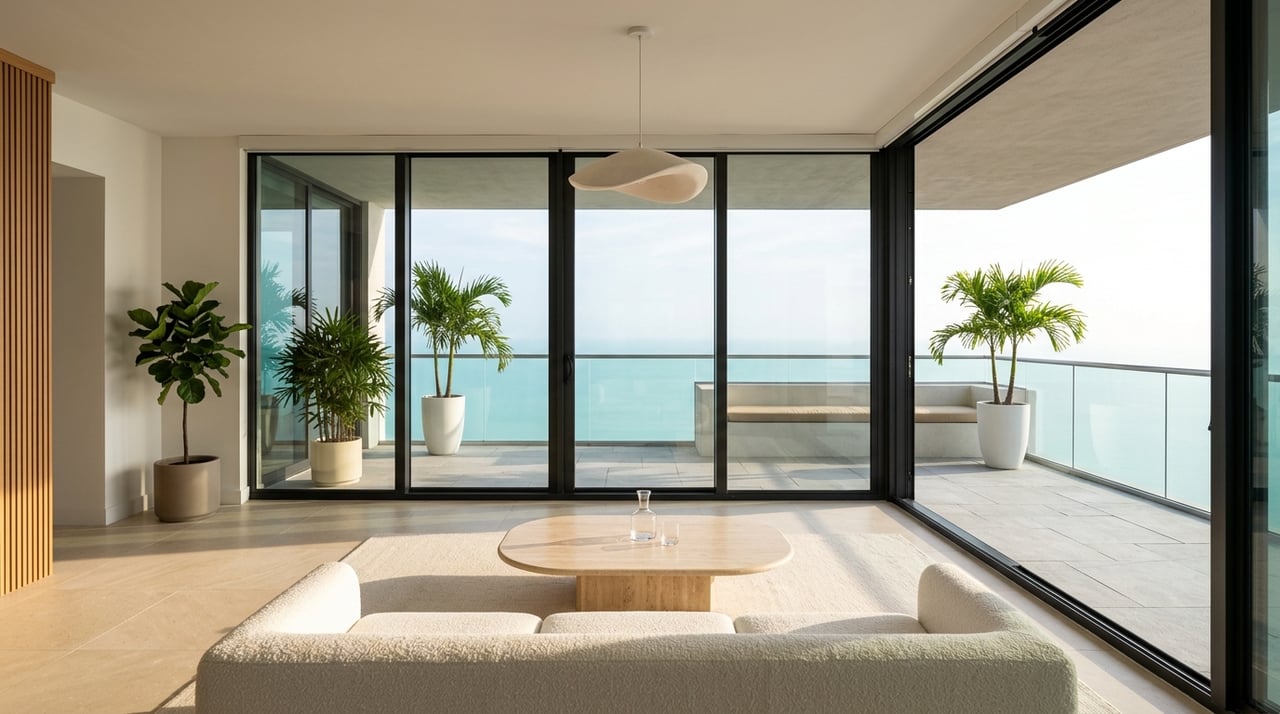
If you have looked at Miami Beach luxury condos and wondered why one unit sells quickly while another sits for months, you are asking the right question. This is not a simple market, and the asking price rarely tells the whole story. Once you understand how cash buyers, building documents, inventory, and true ownership costs shape decisions, the market becomes much easier to read. Let’s dive in.
Why Miami Beach Luxury Condos Behave Differently
Miami Beach is not a typical condo market. MIAMI REALTORS reports that the area is the No. 2 largest vacation-home market in the country, with 13,817 vacation homes making up 22% of the housing stock. That seasonal profile affects how often owners sell, how buyers evaluate carrying costs, and how long it can take the right deal to come together.
This is also a cash-heavy market. In 2025, 82% of Miami-Dade condo sales above $1 million were all-cash, according to MIAMI REALTORS. That matters because sellers often favor clean terms, and buyers who need financing may need a stronger strategy from the start.
The definition of “luxury” here also sits far above the broader condo market. In Q1 2026, MIAMI REALTORS set the Miami Beach condo luxury threshold at $5.5 million and the ultra-luxury threshold at $14 million. That is one reason broad condo headlines can miss what is really happening at the top of the market.
How Pricing Really Works
Luxury condo pricing in Miami Beach is highly segmented. A building on the water, a specific line, a protected view, and the quality of the finishes can all move value in a meaningful way. Two units that look similar on paper may trade very differently in real life.
That is why median price matters more than average price when you are trying to understand the market. Florida Realtors notes that median sale price is usually the better measure because averages can be skewed by a few very high-end deals. In a place like Miami Beach, that distinction is especially important.
The gap between the broader condo market and the luxury tier makes this clear. In the Q3 2025 Elliman report, the broader Miami Beach and Barrier Islands condo market had a median sale price of $580,000 and an average of 120 days on market. In that same report, the top 10% luxury condo segment had a median sale price of $6.4 million, 141 days on market, and an 18.9-month supply.
That means pricing a luxury condo from neighborhood averages alone can lead you in the wrong direction. The better method is to compare same building, same line, same exposure, and similar renovation level whenever possible. In this market, that kind of precision matters.
Why Days on Market Can Be Misleading
A longer market time does not always mean something is wrong with the property. In luxury condos, it often reflects the size of the buyer pool, the seasonality of demand, and how carefully buyers review the building itself. Even a strong listing may need patience.
The numbers support that. In Q3 2025, the Miami Beach and Barrier Islands luxury condo segment averaged 141 days on market and a 9.0% discount from the last asking price, according to Elliman. At the county level, MIAMI REALTORS reported a median of 83 days to contract and 117 days to sale for Miami-Dade condos in February 2026.
Inventory also shapes the pace. MIAMI REALTORS reported 13.4 months of condo inventory in Miami-Dade in February 2026, which signals a buyer’s market. In practical terms, buyers often have options, and sellers need both realistic pricing and strong presentation.
Why Price Per Square Foot Has Limits
Price per square foot is useful, but only when used carefully. It can help you compare properties at a high level, yet it does not capture the full story in a market where view, waterfront position, privacy, and building quality carry so much weight.
The spread across nearby submarkets shows how dramatic those differences can be. In the Q3 2025 Elliman report, Mid-Beach condos averaged $833 per square foot, while Fisher Island condos averaged $2,953 per square foot. That kind of range tells you that location within the market matters just as much as location on a map.
For buyers, this means a lower price per square foot is not always a better value. For sellers, it means your unit should not be priced from broad area math alone. The right benchmark is the closest true comparable, then an adjustment for the details buyers actually pay for.
Resale, New Construction, and Pre-Construction
Not all condo inventory reaches the market in the same way. In Miami Beach and the broader Miami area, resale, new construction, and pre-construction each behave differently, and each calls for a different decision process.
Resale condos usually offer the clearest comparable sales history. You can evaluate recent closings, current competition, and the condition of the exact building in a more direct way. You may also be able to occupy the property sooner, which can be a major advantage.
At the same time, resale requires close review of building-level issues. In Miami Beach, recertification, reserve funding, and special assessments can materially affect the true cost of ownership. A beautiful unit can feel very different once you understand what may be coming at the association level.
New construction and pre-construction are different. MIAMI REALTORS notes that many new-construction sales are not reported in the MLS, which makes pricing less transparent than resale. Their June 2025 new-construction report covered 37 projects and 9,115 units in the Miami market area, and it found that 49% of buyers were international, with Latin American buyers making up 86% of the global share.
That separate sales channel matters because comps can be harder to verify. The sales experience is also often more document-driven than comp-driven. In simple terms, resale is usually a condition and valuation decision, while pre-construction is often a document and delivery decision.
What Florida Condo Disclosures Mean for You
Florida law gives condo buyers important disclosure rights, and those timelines matter. In a developer sale, Florida Statutes 718.503 generally gives a buyer 15 days to void the contract after receiving the required documents. For projects offered before completion, the developer must also make plans and specifications available.
In a resale condo purchase, buyers must receive the association’s declaration, bylaws, rules, recent financials, and FAQ sheet, and they generally have 7 days after receipt to cancel. If milestone inspection or structural integrity reserve study documents apply, those must also be provided.
This is one of the clearest reasons luxury condo buying in Miami Beach should never be reduced to finishes and views alone. The documents help you understand not just what you are buying, but also how the building is operating and what that may mean financially after closing.
Why Building Documents Matter So Much
In Miami Beach, building health is part of property value. The city requires commercial and multifamily buildings built on or after 1993 to be recertified at 30 years and every 10 years after that. Reports must be prepared by a Florida-registered engineer or architect.
Florida also has state-level rules that affect many condo buildings. Milestone inspections are required for condominium and cooperative buildings that are three habitable stories or more at 30 years of age and every 10 years after that, and local enforcement may require the first inspection at 25 years near salt water. Associations must also complete structural integrity reserve studies every 10 years.
These rules are not just technical details. They can affect monthly dues, future assessments, and buyer confidence. Florida law ties reserve funding to the most recent structural integrity reserve study, and funding may come from regular assessments, special assessments, lines of credit, or loans.
Before you make an offer, it is smart to review the association budget, reserve study, milestone-related documents, special assessment history, and the building’s recertification status. Those items often reveal the real cost of ownership more clearly than the listing sheet does.
Why Financing Should Be Checked Early
Even in a luxury market, financing still matters because building approval can become a hurdle. MIAMI REALTORS reported that only 21 of 2,397 condominium buildings across Miami-Dade, Broward, and Palm Beach counties were FHA-approved. While many luxury buyers use cash or conventional financing, this still shows how important project eligibility can be.
If you are buying with financing, early verification can save time and frustration. If you are selling, knowing how your building fits common financing paths can help shape both marketing strategy and buyer screening. In a market where clean terms carry weight, preparation matters.
What Strong Offers Look Like
In Miami Beach luxury condos, the highest offer is not always the winning one. Sellers often look closely at certainty, timing, and how prepared the buyer is to move through due diligence.
Because the market is so cash-heavy, proof of funds or strong financing strength can make a real difference. Shorter due diligence periods, organized document review, and a clear understanding of the building can also improve your position. In a segment where the average listing discount reached 9.0% in Q3 2025, negotiation tends to reward preparation more than emotion.
For sellers, this means the right buyer is not always just the one with the highest number. For buyers, it means strategy should include both valuation and building intelligence. That combination is often what creates a smoother path to closing.
The Bottom Line on Miami Beach Luxury Condos
Miami Beach luxury condos operate in a market shaped by cash buyers, seasonal ownership, wide pricing gaps, and building-level financial realities. Asking price is only one layer. The real story usually sits in the comps, the documents, the reserves, and the building’s long-term condition.
If you are buying, your edge comes from understanding the full cost of ownership before you commit. If you are selling, your advantage comes from pricing with precision and presenting the property in a way that speaks to how luxury buyers actually shop here.
If you want curated guidance on buying, selling, or evaluating a luxury condo in Miami Beach, connect with Tamara Zaikina for personalized support shaped by the local market.
FAQs
What defines a luxury condo in Miami Beach?
- According to MIAMI REALTORS’ Q1 2026 luxury report, the condo luxury threshold in Miami Beach was $5.5 million, and the ultra-luxury threshold was $14 million.
Why do Miami Beach luxury condos stay on the market longer?
- Luxury condos often have a smaller buyer pool, more detailed building review, and higher inventory levels. In Q3 2025, the luxury condo segment in Miami Beach and the Barrier Islands averaged 141 days on market.
What should buyers review before buying a Miami Beach condo?
- Buyers should review the association budget, reserve study, milestone-related documents, special assessment history, recertification status, financials, and governing documents before moving forward.
How are Miami Beach luxury condos usually priced?
- The strongest pricing approach uses same-building, same-line, same-view comparable sales, then adjusts for condition, finishes, and building factors rather than relying on broad neighborhood averages.
Are Miami Beach luxury condo buyers usually paying cash?
- Many are. MIAMI REALTORS reported that 82% of Miami-Dade condo sales above $1 million were all-cash in 2025.
What is the difference between resale and pre-construction condos in Florida?
- Resale is usually driven by comparable sales and current building condition, while pre-construction is more dependent on developer documents, delivery terms, and Florida’s disclosure and cancellation timelines.